Content readiness
The on-site audit. Whether your own pages give AI engines what they need to cite you. This is the cheapest lever in the loop because every fix is entirely in your control.
The six technical chips
At the top of the section, six pass/fail chips show whether your site clears the basic technical bar AI crawlers care about:
| Chip | What it checks |
|---|---|
| Crawlable | robots.txt exists and allows AI crawlers |
| Homepage reachable | The homepage returns 200 and resolves cleanly |
| Canonical tags | Each page declares a canonical URL |
| Schema markup | Organization, Corporation, LocalBusiness, Brand, or WebSite JSON-LD present |
| FAQ schema | FAQPage JSON-LD present so AI can quote your FAQ verbatim |
| llms.txt | Root-level file telling AI crawlers what to read |
A chip is either green (present) or grey (missing). They’re a fast read for engineering: anything grey is a one-PR fix.
The per-axis breakdown
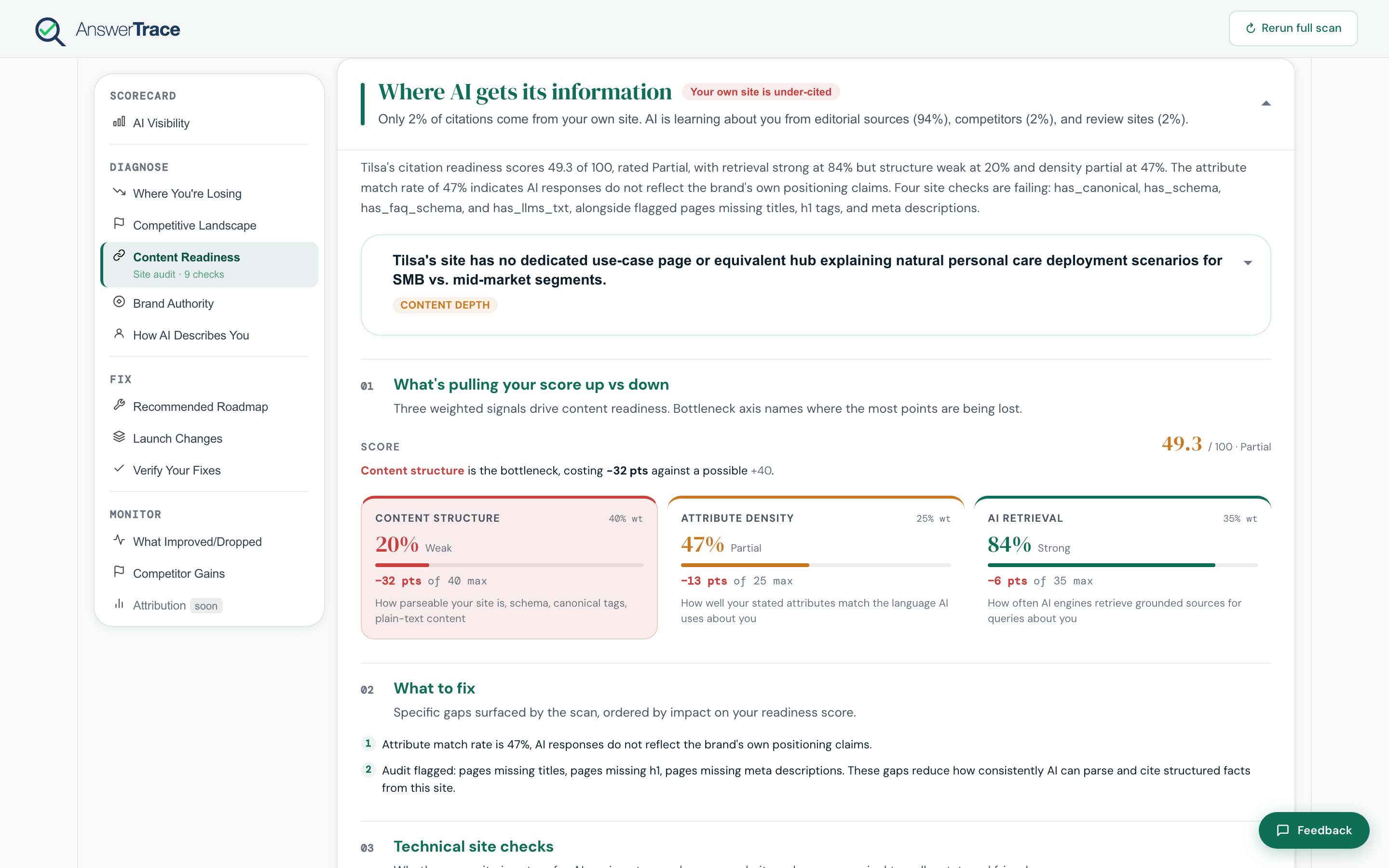
Below the chips, three deeper rollups show each axis with a Strong / Partial / Weak label and a score-out-of-max value:
- Owned content (homepage, About, pricing, blog, key pages)
- Schema and structure (the JSON-LD detail)
- Source signals (sitemap, llms.txt, canonical hygiene)
The overall Content Readiness band shown in the left rail and the report header reads Ready, Partial, or Not ready depending on the weighted total.
Gap diagnosis
Below the breakdown, a What to fix list shows the specific citation-readiness gaps the rule engine surfaced. Each item links to the corresponding artifact on the Launch changes surface so you can generate the JSON-LD snippet, FAQ block, or page skeleton without copy-pasting.
What this means for you
Content readiness is the cheapest lever in the loop. You don’t need backlinks or press. You need pages that answer the questions buyers ask, with the schema and structure AI engines can parse.
Growth and up unlock the ready-to-publish artifact flow that drafts the missing page or schema for you. See Publish to your CMS.