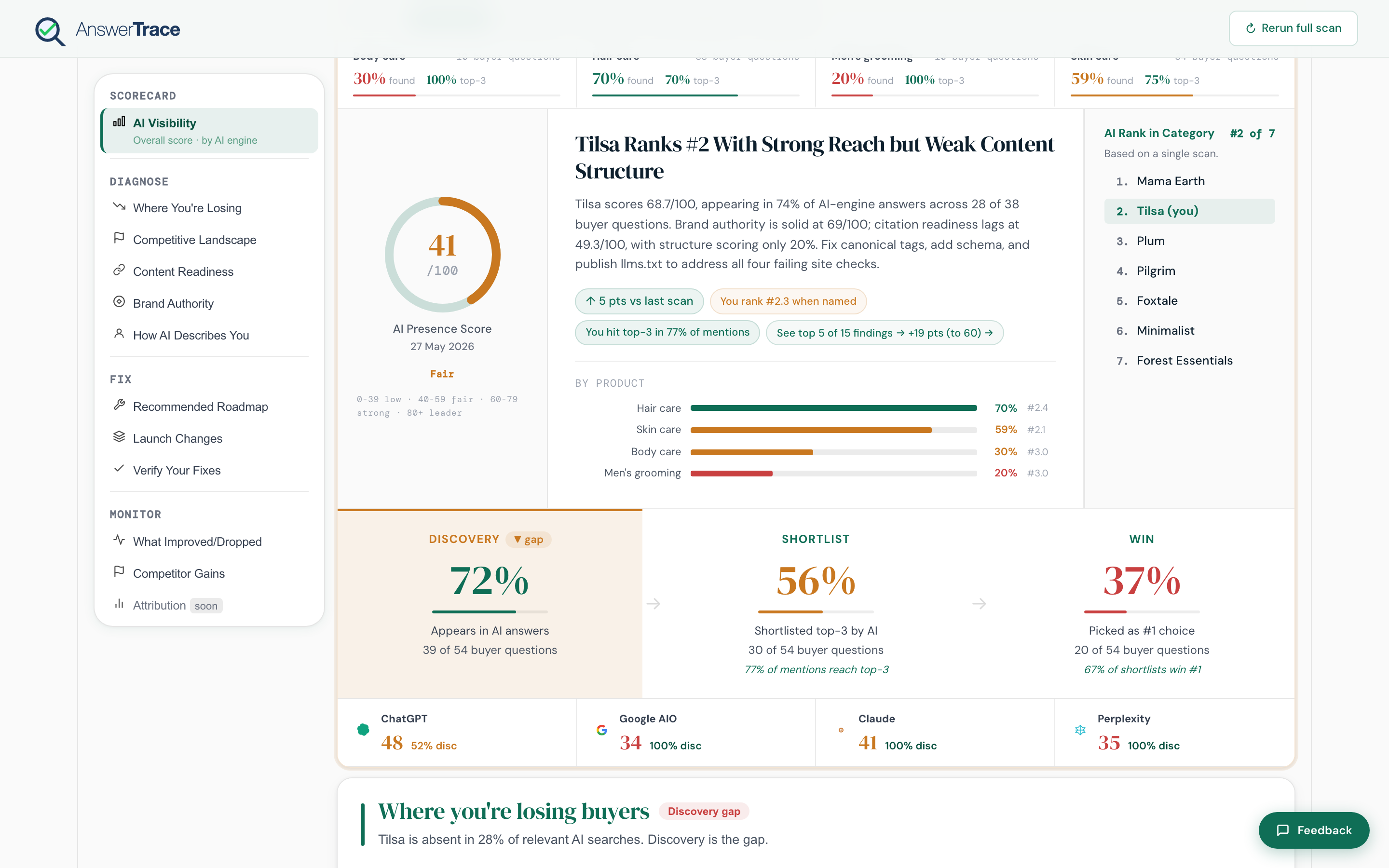
AI rank in category
Your place on a ranked list of the brands in your category: your brand plus the competitors from your brand setup. Number one is the brand on the list that AI names most often.
The report shows your place on that list, not the list itself. You see it in two places:
- Under the AI Presence Score on the Scorecard, as a label like “Ranked · #4 of 8”. In first place it reads “Category leader · #1 of 8”.
- In the bar across the top of the report, as “AI rank #4 of 8”.
The “Share of voice · category rank” card on the Scorecard is a different ranking. It counts every brand AI named, ordered by its share of all mentions, so its number can differ from this one.
How the ranking is built
AnswerTrace ranks brands by how often AI names them in its answers to your buyer questions. Answers from every engine on your plan count, one each, so a question answered by 4 engines gives 4 answers.
- Only real answers count. When the AI asks a question back, refuses, or the call fails, that reply is left out.
- Questions that already name you. Brand questions, where buyers search your brand by name, are left out, since the question supplies your name. In any other question that names you, like “Tilsa vs Plum”, the rivals in the answer still count, but you do not.
- Which brands are ranked. Your brand and the competitors from your brand setup. If there are none, the list is every brand the AI named in those answers.
- Order. The brand named in the most answers is number one. A tie goes to the brand the AI lists higher on average, then to alphabetical order.
- When you get a number. Your rank shows only when the AI names you in at least 2 answers. With fewer, the report shows no number, because a single mention could put you ahead of competitors the AI never named.
The number next to your brand on the report is your place on that list, for example #4 of 8: your brand plus 7 competitors.
Why this is different from the AI Presence Score
| Metric | What it measures |
|---|---|
| AI Presence Score | Your absolute performance, 0 to 100 |
| AI rank in category | Your relative position, #1 to #N |
You can have a strong score and a poor rank if your category has very strong incumbents. You can have a moderate score and a great rank in a small or new category.
Buyers care about rank. If your score went up but you dropped from #3 to #5, a stronger competitor moved past you. Both are true at the same time.
Tracking movement over time
There’s no 30-day rank-history chart on this view. Movement shows up in two other places:
- What improved or dropped, the in-app change feed that captures rank shifts week over week
- Competitor gains, the dedicated competitor-movement view that flags when a rival overtook your #1 spot
When you re-scan, the next report shows the new rank. The history lives in your scan archive (1 year on Starter and Growth, 2 years on Pro), not as a chart on the Scorecard.
What this means for you
Score answers “are we improving”. Rank answers “are we improving faster than the others”. Use both. If rank stays flat while score climbs, the whole category is rising and you haven’t pulled ahead. If rank climbs while score stays flat, competitors are slipping and you’re relatively stronger.