How AI describes you
The diagnostic of language. Not whether you show up, but how engines talk about you when they do. This is the leading indicator for sentiment shifts that show up later in the score.
Sentiment, per engine
For every prompt where your brand was mentioned, AnswerTrace classifies the surrounding sentence as positive, neutral, or negative and stacks the share per engine.
| Sentiment | What it looks like |
|---|---|
| Positive | ”Tilsa is one of the leading natural beauty brands for Indian buyers…” |
| Neutral | ”Tilsa is a natural beauty brand in India.” |
| Negative | ”Tilsa has been flagged for inconsistent delivery times.” |
A consistent positive lean across engines is what you’re looking for. Big gaps between engines (positive on ChatGPT, neutral on Perplexity) tell you which third-party sources the engines are reading.
This block is gated on Starter and up; Free reports show a locked teaser.
Attribute pills
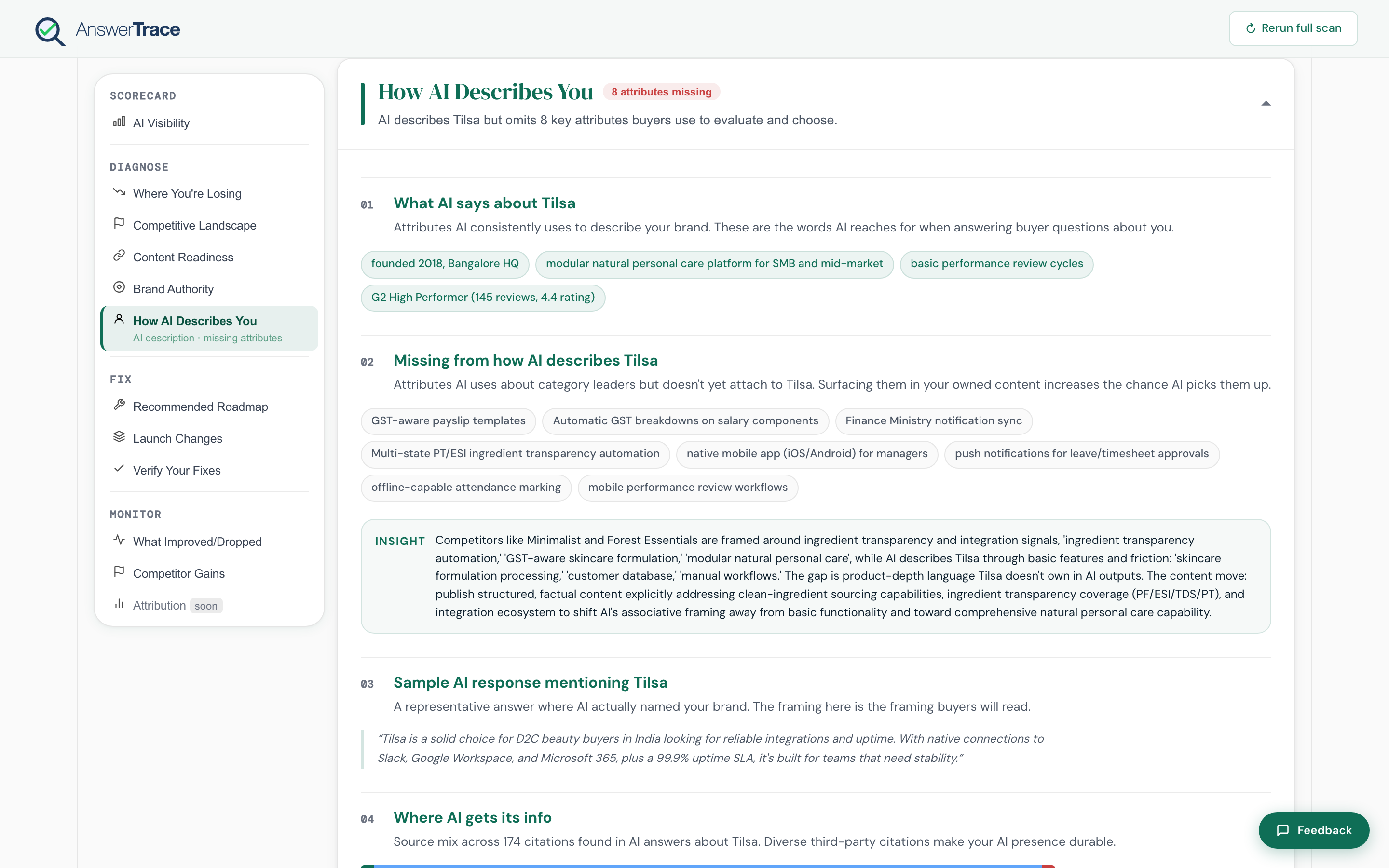
Below sentiment, the section lists the attributes engines consistently associate with your brand as a row of pills. These are extracted across the scan, so a pill that shows up here is one engines mention often, not just once.
If the list is short or generic, engines don’t know much about you. That’s a content readiness gap.
If the list is wrong, your messaging on-site isn’t landing. That’s a positioning fix; rewrite the offending pages.
Where AI gets its info
A fourth sub-block shows the source mix engines used when answering about you: how often they cite your owned domain, how often third-party sources, and how often competitor surfaces. Skewing too far towards “competitor surfaces” means buyers are reading about you through your rivals.
Sample sentence
The section ends with one representative sample sentence pulled from the scan (truncated to fit). It’s there so a non-technical reviewer can see the actual language the engine produced, not just the rollup. To see more examples, open individual prompts from Where you’re losing.
What this means for you
Sentiment moves with press cycles. Attributes move with on-site content. The source mix tells you who’s writing your brand story. Watch all three as leading indicators; if the attributes shift towards your positioning, the score will follow in the next What improved or dropped cycle.